When sewage comes up through a floor drain, a tub or a toilet, the first question is who has to fix the blocked pipe. In Sachse the answer depends on where the blockage sits, and the call goes to a different place during business hours than after them.
Key takeaways
- The city says it is responsible for sewer mains and service laterals up to the customer's property.
- For a backup, residents call Public Works in business hours, and after hours police dispatch sends a crew.
- If the blockage is in the city pipe, the crew clears it. If it is on the customer side, the crew notifies the customer.
- Sewage inside a home is Category 3 water and needs trained cleanup, not a mop and bleach.
- Cleanup and the pipe repair are separate jobs and can happen together.
How Sachse splits sewer responsibility
The City of Sachse says it is responsible for sewer main pipes and for repairs to the service lateral up to the customer's property. Anything on the home side belongs to the owner.
The practical result is two possible blockages. One sits in the street main, and one sits in the pipe that runs from the house toward the street.
Signs the problem is in the main
A city main blockage tends to affect the lowest drains first. Several fixtures back up or gurgle at the same time, and a neighbor may report the same thing.
Signs the problem is on the home side
A single toilet or tub that backs up while the others drain normally points to the home side. A clogged branch pipe, roots or a collapsed section can do the same.
Who to call and when
The city's process for a sewer backup is simple. Residents call Public Works during business hours, and after hours police dispatch sends a crew.
If the blockage is in the city pipe, the crew clears it. If the blockage is in the customer's pipe, the crew tells the customer, who hires a plumber.
The city also notes that a cleanout may be required on a sewer pipe, an access point that lets a crew reach the blockage without opening the ground.
- Business hours: call Public Works and describe which fixtures are backing up.
- After hours: call police dispatch, which sends a crew to check the city main.
- Home side blockage: the owner hires a plumber to clear or repair the pipe.
- The city may require a cleanout, an access point on the sewer pipe, when Public Works or Engineering requires it.
What to do while waiting
A backup keeps pushing water into the house until the blockage clears, so a few steps limit the spread.
- Stop using every drain: no flushing, showers, dishwasher or laundry.
- Keep people and pets out of the wet area.
- Switch off power to any room where water is reaching outlets or floor level equipment.
- Open a window if the odor is strong, and keep the area closed off from the rest of the house.
- Take photographs of the water and the affected floors before cleanup starts.
Why sewage cleanup is different
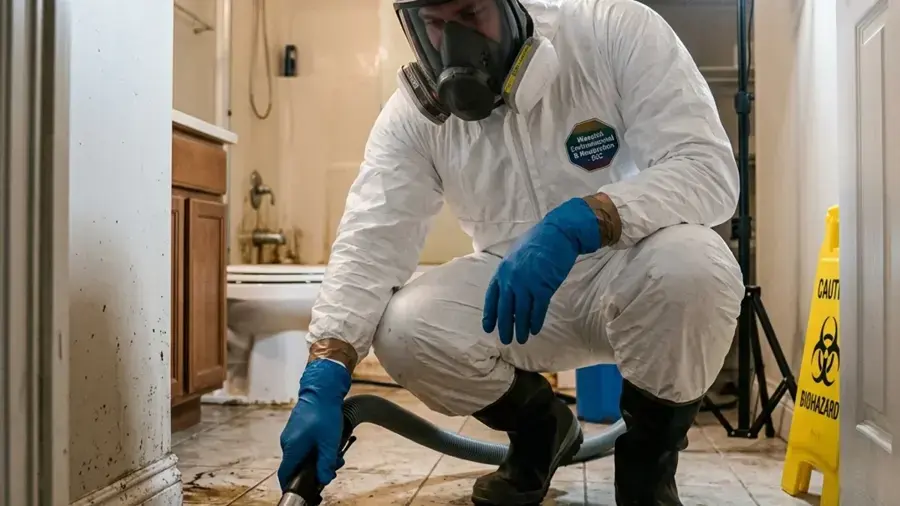
Water from a sewer backup is Category 3, the most contaminated category in restoration work. It can carry bacteria and other contaminants, so the cleanup is built around containment and removal.
A backup that starts at a floor drain can reach carpet, baseboards and cabinet bases quickly, and the soaked material cannot be washed clean.
Containment and removal
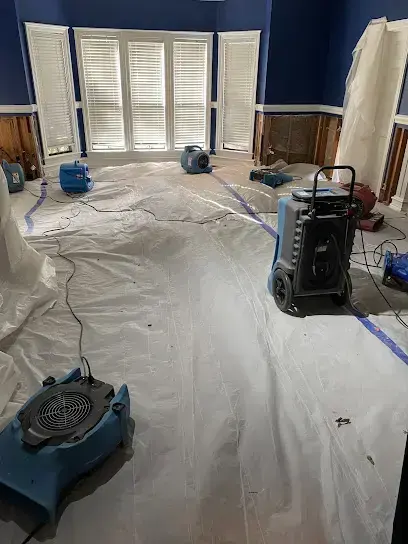
The affected area is closed off, and standing water is pulled out first. Porous materials that touched sewage, including carpet, pad, lower drywall and insulation, are removed and bagged.
Details on the process are on the sewage backup cleanup page for Sachse.
Treatment and drying
Hard surfaces and framing are cleaned and treated with an antimicrobial. Air scrubbers and dehumidifiers run while moisture readings confirm the area is dry.
When it starts as a toilet overflow
Not every sewage event is a street main. A clogged toilet or a blocked branch pipe can overflow a bathroom without involving the city at all.
Clean water from a tank is different from water that came up the pipe. Overflow water from a bowl is handled by category, so the cleanup depends on what the water carried.
See the toilet overflow cleanup information for how that is sorted.
Cleanup while the pipe is being fixed
A blockage takes time to find, and the water inside the house does not wait. Cleanup can start as soon as the backup stops, even while a plumber or the city crew is still working on the pipe.
The order matters. Clearing the pipe first prevents a second flood, and then the rooms are cleaned out and dried.
Starting removal while the pipe is still blocked risks bringing new sewage onto a clean floor.
What the homeowner should not do
Using household cleaners to wash the floor spreads contamination into grout, baseboards and the subfloor. A shop vacuum pulls sewage into the motor and blows it back out as a spray.
Both are better left to a crew with the right equipment.
Why records of the blockage matter
A plumber's note about where the blockage sat helps with the claim and with any later talk with the city. It shows whether the problem was in the street main or on the home side.
Insurance and records
Policies treat sewer backup differently. Many exclude it unless the homeowner added an endorsement, so the first step is to read the policy or ask the insurer.
Write down who was called and when, including the date and time of the call to Public Works or police dispatch. Keep the plumber's report that says where the blockage was found.
That record shows whether the backup came from the city pipe or the home side.
The full list of services for the area is on the Sachse water damage hub.
A drain that backs up repeatedly after heavy use, or only one fixture, is a sign to have a plumber camera the pipe before the next event.
Questions
Who fixes a sewer backup in Sachse?
The city clears blockages in its mains and service laterals up to the customer's property. A blockage on the home side is the owner's, and a plumber handles it.
Who do residents call after hours?
After hours, police dispatch sends a crew to check the city pipe.
Is sewage water dangerous to touch?
Yes. It is Category 3 water and can carry bacteria, so gloves, boots and protective gear are used and contact is avoided.
Can carpet be saved after a sewage backup?
Carpet and pad that sat in sewage water are removed and discarded. They cannot be cleaned reliably.
Does homeowners insurance cover a sewer backup?
It depends. Many policies need a specific endorsement, so the homeowner should check the wording or call the insurer.