Structural Drying and Dehumidification in Rowlett, TX
Surfaces dry fast; framing, wall cavities and the slab do not. The drying team maps moisture, sizes equipment to the class of loss and runs it until every material reads dry.
(888) 527-9134Get the slab and walls drying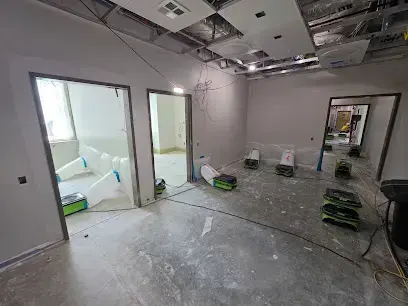
First steps for structural drying and dehumidification in Rowlett
- 1
Stop the water
The source has to be shut off and repaired before drying can finish.
- 2
Open the house up
Open interior doors so dry air can circulate; keep exterior windows closed in humid weather.
- 3
Lift what you can
Move rugs, boxes and furniture off wet floors.
- 4
Call for readings
Moisture meters show what is still wet behind dry-looking surfaces.
How structural drying and dehumidification work is done in Rowlett
Structural drying is the part of water damage restoration that decides whether problems show up months later. A carpet can feel dry in a day while the bottom plate of a wall, the inside of a cavity or the slab under it is still wet. The drying team measures every wet material, sets equipment to the room's evaporation load and keeps it running until the readings, not the surface, say dry.
What does structural drying and dehumidification cost in Rowlett, TX?
In Rowlett, TX, structural drying typically runs $1,500 to $22,000, depending on the class of loss, the square footage, how much equipment the rooms need and how many days drying takes.
Class 1 or 2, one area
$1,500 to $4,000
- Air movers and LGR
- Three to five days
- Daily readings
Class 3, several rooms
$4,000 to $10,000
- Larger equipment set
- Wall cavity drying
- Ceiling drying
Class 4, slab or hardwood
$10,000 to $22,000
- Desiccants and mats
- Longer drying
- Specialty tools
Ranges are typical, not a quote: category of water, square footage, material class and how fast drying started move the number most. Run the Rowlett water damage cost calculator for a closer range.
The structural drying and dehumidification process in four steps
The tech who does the walkthrough maps moisture before any equipment goes down, so the drying plan matches what is actually wet. Equipment stays until the readings say dry, not until it looks dry.
- 1
Map and classify
Meters and thermal imaging set the class of loss and the dry reference.
- 2
Set equipment
Air movers and dehumidifiers are placed to the evaporation load.
- 3
Monitor daily
Readings and psychrometric data are logged every day.
- 4
Verify dry
Equipment leaves when every material meets the dry goal.
Class of loss sets the equipment
IICRC S500 sorts losses into four classes by how much water soaked in and how dense the materials are. A higher class means more air movers, more dehumidification and often specialty tools.
- Class 1: part of a room, little wicking
- Class 2: a whole room, water up the walls
- Class 3: ceilings, walls and floors soaked
- Class 4: dense materials such as the slab, hardwood or plaster
Tools for Rowlett houses
LGR dehumidifiers pull water vapor out of the air even as it gets drier. Desiccant dehumidifiers and drying mats handle the slab and hardwood. Wall cavity drying systems push air into walls through small holes so drywall can stay. Thermal imaging and pinless meters find wet spots without opening anything.
Rowlett's humid springs slow evaporation, so dehumidification matters as much as airflow. Summer heat helps attics dry but loads the air with moisture.
How dry is dry
The goal is a reading within 2 to 4 points of a dry reference material in an unaffected part of the same house. The drying team logs material readings and psychrometric data every day, moves equipment as areas dry and removes it only when the goal is met. See the drying time estimator for a typical window.
- Dry reference taken on day one
- Daily psychrometric logs
- Equipment pulled area by area as it dries
The EPA mold and moisture pages explain the 24 to 48 hour drying window, and Texas A&M AgriLife disaster education covers drying out a home after water damage.
Rebuilding over wet framing or a wet slab traps the water inside, which is why repair work waits until the final readings are in.
Structural drying and dehumidification across Rowlett and the Lake Ray Hubbard area
The Rowlett restoration crew covers ZIP 75088, 75089 and 75030, from Downtown Rowlett and Lakeview Parkway out along Dalrock Road, Miller Road and Chiesa Road to Waterview and the Lake Ray Hubbard shoreline.
Nearby coverage reaches Garland, Sachse, Rockwall, Heath, Sunnyvale, Wylie.
Related water damage services in Rowlett
Structural Drying and Dehumidification questions in Rowlett, TX
What is an LGR dehumidifier?
A low grain refrigerant dehumidifier keeps pulling water out of the air even at lower humidity, which speeds drying.
Why keep windows closed?
In humid Rowlett weather, outside air carries more moisture in. Dehumidifiers dry a closed house faster.
Can walls dry without being opened?
Often. Wall cavity drying systems push air through small holes. Category 3 water or saturated drywall still needs removal.
How long does structural drying take?
Most Class 1 and 2 losses dry in three to five days. Class 4 materials such as a slab or hardwood take longer.
What is a dry reference?
A reading from the same material in an unaffected part of the house. Wet materials are dry when they read within 2 to 4 points of it.
Why do readings matter for insurance?
Daily readings show the insurer what was wet, how it was dried and why equipment stayed as long as it did.
Still dealing with it?
Want your Rowlett home dried right? Talk to the drying team.
Wet walls or slab in Rowlett? Start the dry-out now.
A house that only looks dry can hold water in the framing and slab for weeks.
(888) 527-9134Rowlett structural drying, any hour