Structural Drying and Dehumidification in Rockwall, TX
After the water is out, the building still holds moisture. The Rockwall crew sets air movers and dehumidifiers by class of loss and tracks readings in framing, flooring and concrete until they match a dry reference.
(888) 527-9134Building still damp? Start drying now.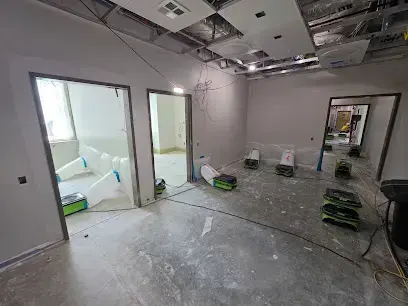
First steps for structural drying and dehumidification in Rockwall
- 1
Stop the water
Make sure the source is repaired or shut off before drying equipment goes in.
- 2
Open the space
Remove soaked pad and loose materials so air can reach the wet surfaces.
- 3
Keep doors closed
Closed rooms hold the conditions the dehumidifiers are working toward.
- 4
Leave equipment alone
Let the crew move and adjust it as readings change.
How structural drying and dehumidification work is done in Rockwall
Water that is pumped out is only half of a dry-out. Framing, subfloor, concrete and the air itself still hold moisture. Structural drying is the controlled process of pulling it out, and in Rockwall's hot, humid climate meters set the pace of the work, not guesses.
What does structural drying and dehumidification cost in Rockwall, TX?
Structural drying in Rockwall, TX commonly runs $1,500 to $22,000. The total follows the class of loss, the materials involved and how many days of equipment and monitoring the readings call for.
Class 1 or 2, one area
$1,500 to $4,000
- One room or area
- Air movers and one dehumidifier
- Daily readings
Class 3, several rooms
$4,000 to $10,000
- Several rooms
- More equipment
- Wall cavities dried
Class 4, slab or hardwood
$10,000 to $22,000
- Dense materials
- Mats and desiccants
- Extended monitoring
Ranges are typical, not a quote: category of water, square footage, material class and how fast drying started move the number most. Run the water damage cost calculator for a closer range.
The structural drying and dehumidification process in four steps
The tech who does the walkthrough maps moisture before any equipment goes down, so the drying plan matches what is actually wet. Equipment stays until the readings say dry, not until it looks dry.
- 1
Classify
The loss class and water category are set from meter readings and a thermal scan.
- 2
Place
Air movers, dehumidifiers and desiccant units are placed room by room.
- 3
Monitor
Temperature, humidity and moisture readings are logged each day.
- 4
Release
Equipment is removed once materials read near the dry reference.
How loss classes set the plan
The drying standard sorts each loss by class. Class 1 is low evaporation with little wet material, and Class 2 is a larger wet area. Class 3 means water came from above, and Class 4 covers dense materials such as concrete and hardwood that release water slowly.
Equipment on the job
Equipment is matched to the room, then moved as readings change.
- Air movers across wet surfaces
- LGR dehumidifiers pulling water from the air
- Desiccant units for dense materials
- Drying mats on floors and slabs
Why humid weather matters
Hot, humid air holds more water, so a room that is open to the outside can undo drying progress. Closed rooms and dehumidifiers keep the target conditions steady until materials reach readings near a dry reference.
Monitoring and closing out
A daily visit logs temperature, humidity and moisture readings, and the log goes into the claim file. Equipment leaves only when materials read dry. See water extraction for the step that comes before drying, and Rockwall water damage restoration for every service in town.
What the records show
Each daily visit adds a row to the drying log: indoor temperature, relative humidity and the moisture reading of each tracked material. Over a few visits the numbers fall toward the dry reference, and that trend is what an adjuster reads to confirm the drying was real and complete.
When drying runs long
Dense or layered materials such as hardwood over a subfloor, concrete slabs and walls with thick insulation give up water slowly. Extra days of equipment are not a sign of a problem. They are the readings telling the crew that moisture is still coming out, and hardwood and slab jobs in particular depend on mats.
A wall can look dry while its cavity is still wet, which is why a meter reading beats a visual check.
Structural drying and dehumidification across Rockwall and nearby towns
Structural drying work covers ZIP codes 75087 and 75032, including Chandlers Landing, The Shores, Stone Creek, Hickory Ridge, Lake Rockwall Estates, Castle Ridge, Park Place and the downtown square area.
The same service nearby: structural drying and dehumidification in Rowlett, Heath, Sachse.
Related water damage services in Rockwall
Structural Drying and Dehumidification questions in Rockwall, TX
Why does drying take longer than pumping?
Pumping removes liquid water, but moisture left in framing, subfloor and concrete leaves slowly as vapor, so it takes controlled drying.
How do you know when a structure is dry?
Moisture meters measure framing and other materials and compare them with a dry reference taken in an unaffected area.
Are loud fans and dehumidifiers really needed?
Yes. Air movers sweep moisture off surfaces and dehumidifiers remove it from the air, and the two work together.
Can I turn the equipment off at night?
It should run continuously, because stopping lets moisture settle back into materials and slows the whole job.
Does humid weather slow drying?
It can, since humid air holds more water. Closed rooms and dehumidifiers keep conditions steady so drying keeps moving.
Is structural drying part of insurance documentation?
Yes. Daily moisture and psychrometric readings show how the structure dried, and that record supports the claim.
Still dealing with it?
Damp building after a water loss? Get structural drying started.
Moisture still in the walls? Call for drying today.
Moisture left in framing and concrete keeps causing problems until readings come down to a dry reference.
(888) 527-9134Rockwall drying help, any hour