
Duck Creek runs through Garland, and when heavy rain pushes it out of its banks the water comes fast. In late May 2015 it flooded Garland homes, and some residents had about 20 minutes to get out.
Key takeaways
- FEMA maps show about 4,200 acres of 100 year floodplain in Garland, mainly along Duck Creek, Rowlett Creek and Spring Creek.
- Creek water that enters a house is contaminated and should be treated that way from the start.
- Safety comes first: no walking into standing water, no touching electrical items while wet.
- Photographs and a written list of damage come before anything is thrown out.
- Extraction and drying within the first day limits how far water travels into walls and subfloors.
Why Duck Creek matters in Garland
Duck Creek crosses the city, and Rowlett Creek and Spring Creek add to the flood picture. FEMA flood maps show about 4,200 acres of 100 year floodplain in Garland, mainly along those three creeks and their tributaries.
A 2025 city work session described flooding from Duck Creek and Rowlett Creek. The May 2015 event is the one many residents remember, because it put water inside homes along the creek.
Where the creek runs
The Duck Creek Greenbelt Trail follows the creek past Troth Ablon Park, Gatewood Park and Cody Park. Homes near that greenbelt and the other creek corridors sit closest to the water.
Historic Downtown Garland also grew up around Duck Creek, so older buildings sit near the same drainage.
Safety before anything else
A flooded house is not safe to walk into until the basics are checked. Water, electricity and slippery floors are a bad mix.
If water is still rising, the answer is to leave, not to move belongings.
- Stay out of rooms with standing water until the power to them is off at the panel, and do not touch the panel while standing in water.
- Avoid wading through moving water outside. Six inches of fast water can knock an adult over.
- Do not use appliances, outlets or extension cords that got wet.
- Wear boots, gloves and a mask when walking through creek water or mud.
- Keep children and pets out of the flooded area.
Treat creek water as contaminated
Creek flood water carries mud, runoff, yard chemicals and sometimes sewage. In the May 2015 flood, one Garland family had raw sewage back up into the home.
That is why storm flood work is handled differently from a clean supply pipe leak. Porous materials that touched the water, like carpet, pad, lower drywall and insulation, are usually removed rather than saved.
- Carpet and pad that sat in creek water are removed and thrown out.
- Drywall that wicked water is cut out above the wet mark.
- Hard surfaces such as concrete, tile and framing are cleaned and treated, then dried.
- Upholstered furniture that soaked in flood water is hard to clean and often discarded.
Document the loss before hauling it out
Insurance adjusters ask for proof, and a flooded home fills quickly with piles of damaged contents.
Photograph the high water mark on each wall, every damaged item, and the rooms before and after any removal. Write down the date and the time when the water came in and when it went down.
After the 2015 event, the City of Garland said it was not responsible for plumbing issues inside homes, and a sewage backup needed a special rider on a homeowner policy. A homeowner should ask the insurer which type of water loss the policy actually covers.
What extraction and drying look like
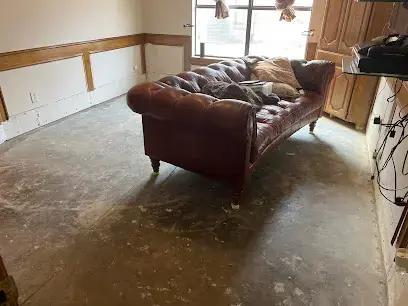
The goal on the first day is to get the water out and start drying. A truck mounted unit or portable pumps pull standing water off the floor.
Read about the water extraction work and the larger storm flood cleanup steps that follow.
Extraction first
Standing water comes out of the house first, room by room. Mud is shoveled or vacuumed once the water is gone.
Removing the bulk of the water early keeps it from soaking further into the subfloor and wall cavities.
Then cleaning and drying
Hard surfaces are cleaned and treated with an antimicrobial. Air movers and dehumidifiers then run while moisture readings track the walls, floors and framing.
Wall cavities behind removed drywall are checked and dried before the house is closed up again.
Contents, electronics and what to set aside
Flooded homes fill with decisions about belongings. Some items can be saved with fast cleaning, and others cannot be made safe again.
Anything that touched creek water should be sorted before it goes back inside. Photograph each pile first, so the claim has a record of what was lost.
- Electronics, small appliances and cords that sat in water should not be plugged in until a technician checks them.
- Solid wood and metal furniture can often be cleaned and dried outside.
- Mattresses, stuffed toys and upholstered pieces that soaked are usually thrown out.
- Papers, photos and documents can be laid flat to dry or frozen until they can be handled.
After the first day
Drying a flooded house also depends on what is behind the walls. Wet framing and cavities are covered under structural drying, and a crew can compare the readings against a dry reference before the walls are closed.
Drying a flooded home takes several days, and readings decide when it is finished, not the calendar.
Garland's own help programs are worth knowing about. In June 2024 the city listed storm help that included the Emergency Storm Home Repair Assistance Program and Crisis Cleanup.
A homeowner can ask the city which programs apply after a new event.
Ask the crew for the daily moisture numbers and keep them with the claim file. Visit the Garland water damage hub for the other services that apply once the house is dry, and call a plumber if a pipe was damaged in the flood.
- Replace air filters and have the heating and cooling system checked if it sat in water.
- Keep receipts for hotel stays, equipment and cleanup supplies.
- Hold damaged items until the adjuster has seen them, or photograph them first.
- Plan flooring and drywall replacement only after readings show the structure is dry.
Questions
How soon should extraction start after creek flooding?
As soon as it is safe to enter. The longer water sits, the further it moves into walls and subfloors.
Is Garland flood water considered contaminated?
Creek flood water carries runoff and sometimes sewage, so it is treated as contaminated and cleaned and removed accordingly.
Does homeowners insurance cover creek flooding?
Standard policies often exclude flood from outside water. A separate flood policy or rider may apply, so the homeowner should ask the insurer before filing.
Can wet drywall be saved after a creek flood?
Drywall that wicked creek water is normally cut out above the wet mark because it holds contaminants.
What should be photographed first?
The highest water mark on each wall, damaged contents and every affected room, before anything is moved or thrown out.